Need help? Reach us at 

 +1 (855) 418-2323
Need help? Reach us at
+1 (855) 418-2323

 File Converters TIFF and PDF apps Forensic Freeware
MP3 is the most widely distributed audio format on the planet, but it was designed in the early 1990s. AAC (Advanced Audio Coding) is the successor standard: at the same bitrate, it delivers noticeably better audio quality, and it is the native format for every iPhone, iPad, Mac, and iTunes library. If your MP3 files refuse to import cleanly into Apple Music, fail a platform's codec check, or simply take up more space than they should, converting to AAC is the direct solution.
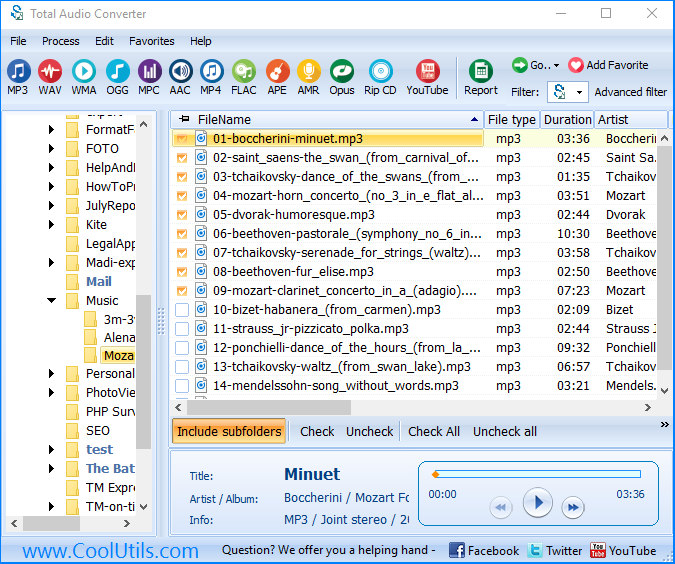
Total Audio Converter converts MP3 to AAC in batch — select a folder, choose the output format and bitrate, click Convert. No file count limit, no uploads to a server, no subscription.
Quick answer: To convert MP3 to AAC, install Total Audio Converter, select your MP3 files, choose AAC as the output format, set the bitrate, then click Start. The whole folder converts offline in one batch, with ID3 tags and cover art carried over.
(includes 30 day FREE trial)
(only $24.90)
MP3 (MPEG-1 Audio Layer III) was standardized in 1993 and became the defining format of digital music distribution. It is universally supported by every device and platform ever made. However, its compression algorithm is older and less efficient: to achieve transparent audio quality, MP3 typically needs 192–320 kbps. The format has no official container for metadata beyond the ID3 tag appended to the file.
AAC (Advanced Audio Coding) was developed by the MPEG group in 1997 as MP3's designated successor. It uses a more sophisticated psychoacoustic model and achieves equivalent perceived quality at roughly 70% of the MP3 bitrate — a 128 kbps AAC file generally sounds comparable to a 192 kbps MP3. AAC is the standard format for Apple's entire ecosystem: iTunes Store purchases, Apple Music, iPhone ringtones, and iPod libraries all use AAC. It is also the audio codec inside most MP4 videos and the preferred format for YouTube audio tracks.
Both MP3 and AAC are lossy formats. Converting MP3 to AAC is a lossy-to-lossy transcode — the original MP3 compression artifacts are already baked in, and the AAC encoder adds a second compression pass. Some quality degradation is unavoidable. Converting at a high AAC bitrate (192 kbps or above) keeps the added degradation minimal and usually imperceptible.
| Feature | MP3 | AAC |
| Introduced | 1993 | 1997 |
| Compression efficiency | Standard | ~30% better than MP3 |
| Native support on iOS/macOS | Yes | Yes (preferred) |
| Native support in iTunes / Apple Music | Yes (import only) | Yes (native library format) |
| Typical quality bitrate | 192–320 kbps | 128–256 kbps |
| Used in MP4 video | No | Yes (standard audio track) |
| Lossy | Yes | Yes |
Total Audio Converter includes a command-line version for server use and automation. Example command:
TotalAudioConverter.exe C:\Music\MP3\ C:\Music\AAC\ -c AAC -b 192
This converts all MP3 files in the source folder to AAC at 192 kbps and saves them to the output folder. Wrap this in a .bat file and schedule it with Windows Task Scheduler to automate regular conversions — useful for media library ingestion pipelines or podcast production workflows that require AAC output.
If you have hundreds or thousands of MP3 files — ripped CDs, downloaded albums, archived recordings — converting them individually is not realistic. Total Audio Converter processes entire folder trees in a single operation. Enable recursive mode and every subfolder is included. Start the conversion and walk away.
MP3-to-AAC is a lossy-to-lossy conversion. The only way to minimize the added degradation is to convert at a sufficiently high AAC bitrate. Total Audio Converter lets you set any bitrate from 64 to 320 kbps per conversion profile. For music, 192 kbps AAC is a practical floor; for archival or critical listening, 256 kbps is safer. The choice is yours — the converter does not impose a fixed setting.
MP3 files store metadata as ID3 tags. AAC files use iTunes-compatible metadata fields. Total Audio Converter reads the ID3 data and writes it into the output AAC file correctly. Track title, artist, album, year, track number, genre, and embedded cover art all transfer. You do not need to re-tag your library after conversion.
All processing runs on your local CPU. Your audio files are never sent to a remote server. This matters for unreleased recordings, private archives, or any content you are not ready to share with a cloud service.
After installation, Total Audio Converter integrates into the Windows Explorer context menu. Right-click any MP3 file or folder, choose Convert, pick AAC — the conversion starts without opening the main application window. Useful for one-off files when you do not need batch mode.
| Feature | Online converters | Total Audio Converter |
| File size limit | Typically 50–200 MB | No limit |
| Batch conversion | ✘ Usually one file at a time | ✓ Unlimited batch |
| Files uploaded to server | ✘ Yes | ✓ No — local only |
| Bitrate control | Limited or fixed | ✓ Full control (64–320 kbps) |
| Tag preservation | Inconsistent | ✓ Full |
| Command-line / automation | ✘ No | ✓ Yes |
| Works offline | ✘ No | ✓ Yes |
| Conversion speed for large batches | Slow (upload + server queue) | Fast (local CPU) |
(includes 30 day FREE trial)
(only $24.90)
Download free trial and convert your files in minutes.
No credit card or email required.