Need help? Reach us at 

 +1 (855) 418-2323
Need help? Reach us at
+1 (855) 418-2323

 File Converters TIFF and PDF apps Forensic Freeware
You recorded a voice message on Discord, saved a call from WhatsApp, or archived a Zoom meeting. The file is in OPUS format — and it won't play on your car stereo, MP3 player, or any device that isn't a browser or a chat app. MP3 plays everywhere. Converting OPUS to MP3 is the direct fix.
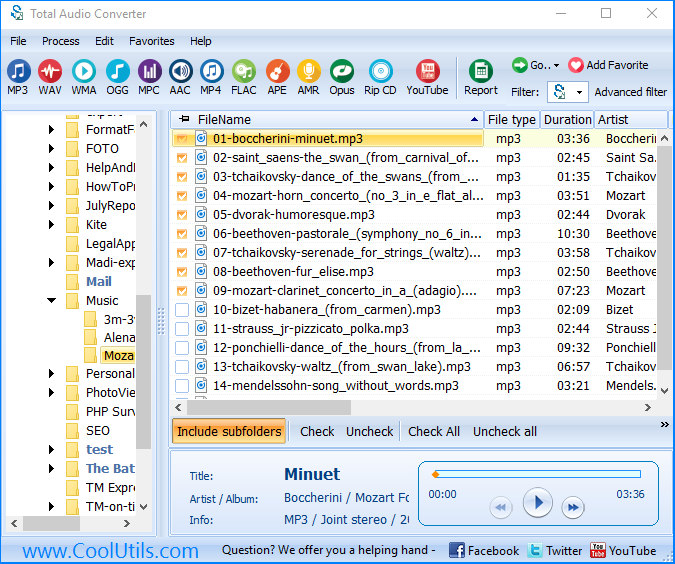
Total Audio Converter handles OPUS to MP3 conversion in batch — pick a folder, set the output bitrate, click Convert. No file count limit, no quality loss beyond what MP3 encoding involves.
Quick answer: To convert OPUS to MP3, install Total Audio Converter, select your OPUS files, choose MP3 as the output format, set the bitrate, then click Start. The whole folder converts offline in one batch, with no file-count limit.
(includes 30 day FREE trial)
(only $24.90)
OPUS is a modern open-source audio codec developed by the IETF and standardized in 2012. It was designed for real-time communication: low latency, excellent quality at low bitrates (as low as 6 kbps), and efficient encoding of both speech and music. Discord, WhatsApp, Telegram, Zoom, and most WebRTC-based applications use OPUS for voice and audio. OPUS files are typically stored inside an Ogg container with the .opus extension. Despite being technically superior to MP3 in terms of compression efficiency, OPUS has almost no hardware support outside of software applications and web browsers.
MP3 (MPEG-1 Audio Layer III) was standardized in 1993. It is the most widely deployed audio format in history. Every car stereo, every portable MP3 player, every smart TV, every mobile OS, and virtually every media application supports MP3 natively. The codec is older and less efficient than OPUS — an MP3 file at 128 kbps sounds noticeably worse than an OPUS file at 64 kbps — but that does not matter when the goal is compatibility rather than compression efficiency.
| Feature | OPUS | MP3 |
| Developer | IETF / Xiph.Org | MPEG / Fraunhofer |
| Year standardized | 2012 | 1993 |
| Container | Ogg (.opus) | Standalone (.mp3) |
| Typical bitrate range | 6–510 kbps | 32–320 kbps |
| Quality at low bitrate | Excellent | Poor–Fair |
| Hardware device support | Almost none | Universal |
| Browser / app support | Excellent | Universal |
| Primary use case | VoIP, chat apps, streaming | Music, podcasts, general audio |
Total Audio Converter includes a command-line version for server use and automation. Example command:
TotalAudioConverter.exe C:\Recordings\OPUS\ C:\Recordings\MP3\ -c MP3 -b 192
This converts all OPUS files in the source folder to MP3 at 192 kbps. You can wrap this in a .bat script and schedule it with Windows Task Scheduler — useful for automatically processing new Discord exports or chat archive dumps as they arrive in a folder.
If you have hundreds of Discord voice clips, WhatsApp exports, or Zoom session recordings, converting them one by one is not practical. Total Audio Converter processes entire folder trees in a single operation. Enable recursive mode and subfolders are included automatically.
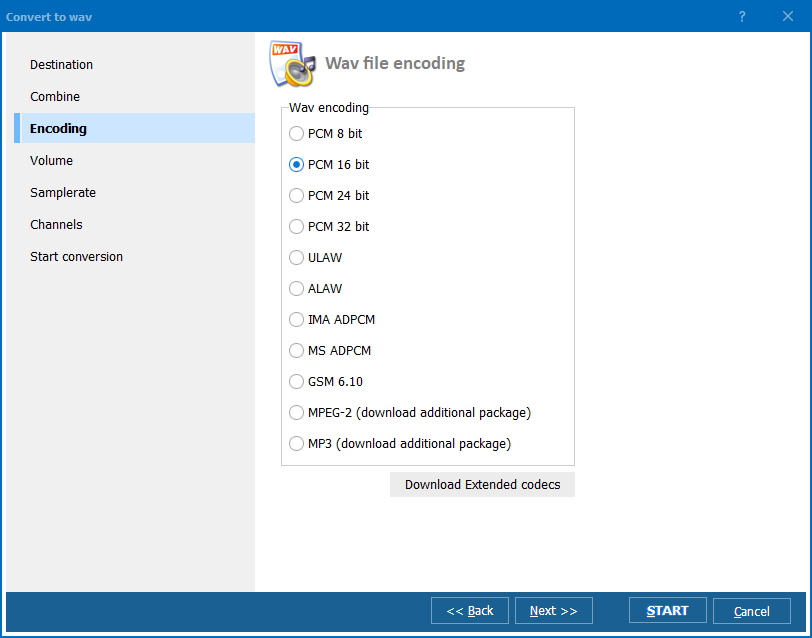
The converter does not apply a fixed bitrate. You choose: 128 kbps for compact files that still sound acceptable for speech, 192 kbps for music recordings, 320 kbps for the highest MP3 quality. This lets you balance file size against playback quality for your specific use case.
All processing is local. Your audio files are never uploaded to a server. This matters when working with private voice messages, confidential meeting recordings, or any content you do not want to transmit over a network.
Where OPUS files contain embedded metadata — title, artist, or comment fields — Total Audio Converter reads those tags and writes them into the MP3 output. You do not need to re-tag files manually after conversion.
After installation, Total Audio Converter adds a context menu entry in Windows Explorer. Right-click any OPUS file, choose Convert, and pick MP3 — the conversion starts without opening the main application window.
| Feature | Online converters | Total Audio Converter |
| File size limit | Typically 50–200 MB | No limit |
| Batch conversion | ✘ Usually one file at a time | ✓ Unlimited batch |
| Files uploaded to server | ✘ Yes | ✓ No — local only |
| Private recordings stay private | ✘ No guarantee | ✓ Yes |
| Command-line / automation | ✘ No | ✓ Yes |
| Works offline | ✘ No | ✓ Yes |
| Conversion speed for large batches | Slow (upload + server queue) | Fast (local CPU) |
(includes 30 day FREE trial)
(only $24.90)
Download free trial and convert your files in minutes.
No credit card or email required.