Logo
Home Products Support Contact About Us
arrow1 File Converters
arrow1 TIFF and PDF apps
arrow1 Forensic
arrow1 Freeware

Convert WAV to AAC


WAV files are uncompressed. A single 3-minute song takes 30 MB or more. That is fine for a studio workstation, but impractical for distribution, mobile storage, or upload to streaming platforms. AAC (Advanced Audio Coding) compresses the same audio to roughly 4–6 MB with no perceptible quality difference at standard listening conditions.

AAC is the native format for Apple devices, iTunes, Apple Music, and YouTube. Most podcast hosts accept it. If your audio library is in WAV and you need it somewhere other than your local hard drive, converting to AAC is the direct solution.

Total Audio Converter handles WAV to AAC conversion in batch — select a folder, choose AAC as the output format, set your bitrate, and click Convert. No file count limit, no upload required, no internet connection needed.

Download Now!

(includes 30 day FREE trial)

Buy License

(only $49.90)

Key Features

  • Batch processing. Convert an entire folder of WAV files in one operation. The converter processes them sequentially without manual intervention per file.
  • Adjustable AAC bitrate. Choose from 64 to 320 kbps. Use 128 kbps for podcast audio, 192–256 kbps for music where quality matters.
  • Tag preservation. Artist, album, track title, track number, and embedded cover art carry over from WAV (if present) to the AAC output file.
  • Command-line interface. Automate recurring conversions with a single command or schedule them with Windows Task Scheduler using a .bat script.
  • Built-in audio player. Preview source WAV files inside the application before converting to verify you have the right recordings.
  • No internet required. All conversion runs locally on your machine. Your audio files are never sent to a server.

WAV vs AAC: What Is the Difference?

WAV (Waveform Audio File Format) stores uncompressed PCM audio. Every sample is written verbatim — no codec processing, no data reduction. The result is perfect fidelity: what went in comes out exactly. That is why WAV is standard in recording studios, broadcast production, and audio mastering. The downside is file size. A 16-bit stereo WAV at 44.1 kHz produces roughly 10 MB per minute. A full album in WAV can exceed 500 MB.

AAC (Advanced Audio Coding) is a lossy codec standardized by the MPEG group in 1997. It uses psychoacoustic modeling to discard audio data that human hearing cannot reliably perceive — frequencies masked by louder sounds, very low amplitudes, and content above the practical hearing ceiling. At 128 kbps, a 3-minute AAC file is around 2.9 MB. At 256 kbps it is around 5.8 MB. Most listeners cannot distinguish a 256 kbps AAC track from the original WAV in blind testing. AAC is the native audio codec for Apple devices, iTunes, Apple Music, YouTube, and most streaming services. It replaced MP3 as Apple's default format in 2003.

FeatureWAVAAC
CompressionNone (lossless PCM)Lossy (psychoacoustic)
Typical file size (3 min)~30 MB~3–6 MB
Audio qualityBit-perfect originalPerceptually transparent at 128+ kbps
Native iOS / macOS supportYesYes (native)
Native Windows supportYesYes (Win 10/11)
Streaming platform supportRarely accepted for uploadWidely accepted
Typical use caseStudio recording, mastering, archivingDistribution, mobile, streaming

How to Convert WAV to AAC

  1. Download and install Total Audio Converter. The 30-day trial is fully functional — no email or credit card required.
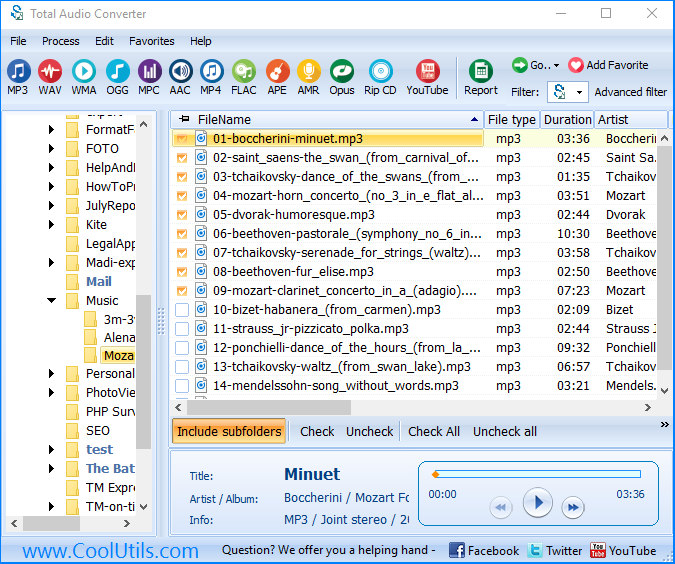
  2. Open the program. The left panel shows your folder tree. Navigate to the folder containing your WAV files.
  3. Check the boxes next to the files you want to convert. Use Ctrl+A to select all files in the current folder at once.
  4. Click AAC in the format toolbar at the top of the window.
  5. In the conversion settings dialog, set the AAC bitrate (128 kbps is suitable for voice and podcasts; 192–256 kbps for music). Choose a destination folder for the output files.
  6. Click Start. The converter processes each WAV file and saves the AAC output to the selected folder. A progress bar shows status per file.

Command-Line Conversion

Total Audio Converter includes a command-line version for server use and scripted automation. Example command:

TotalAudioConverter.exe C:\Audio\WAV\ C:\Audio\AAC\ -c AAC -b 192

This converts all WAV files in the source folder to AAC at 192 kbps and saves them to the output folder. You can wrap this in a .bat file and run it on a schedule with Windows Task Scheduler — useful for automated ingest pipelines, media server libraries, or any workflow that regularly produces new WAV recordings that need to be distributed.

Why Use Total Audio Converter?

Processes large WAV libraries without manual work

Studio sessions, field recordings, and CD rips often produce hundreds of WAV files. Converting them individually is not practical. Total Audio Converter processes entire folder trees in one operation. Enable recursive mode and it descends into subfolders automatically — useful when your archive is organized by artist, album, or project.

You control the output bitrate

Different use cases require different file sizes. A 64 kbps AAC works for a voice-only podcast that needs the smallest possible download. A 256 kbps AAC suits music being uploaded to Apple Music or distributed to audiophile listeners. Total Audio Converter does not apply a fixed bitrate — you choose the value that matches your target platform and audience.

Tags carry over correctly

When WAV files contain metadata (embedded in BWF or ID3 chunks), Total Audio Converter reads those tags and writes them into the AAC container as iTunes-compatible metadata. Track title, artist, album, year, and track number all carry over. You do not need to re-tag the output files after conversion.

Conversion runs offline — your files stay private

All processing happens on your local CPU. No files are uploaded. This matters for unreleased music, confidential recordings, broadcast material under embargo, or any audio you cannot legally transmit to a third-party server.

Windows Explorer integration

After installation, Total Audio Converter adds a context menu entry in Windows Explorer. Right-click any WAV file or folder, choose Convert, and select AAC — the conversion starts without opening the main application window. Useful for quick one-off conversions during a session.

Online Converters vs Desktop Converter

FeatureOnline convertersTotal Audio Converter
File size limitTypically 50–200 MBNo limit
Batch conversion Usually one file at a time Unlimited batch
Files uploaded to server Yes No — local only
Custom bitrate controlRarely available Full control (64–320 kbps)
Tag preservationInconsistent Full
Command-line / automation No Yes
Works offline No Yes
Speed for large batchesSlow (upload + server queue)Fast (local CPU)

When Do You Need WAV to AAC Conversion?

  • Uploading to Apple Music or iTunes. Apple Music for Artists and iTunes Connect accept AAC (.m4a) as the primary delivery format. WAV files are not accepted directly for most submission workflows. Converting to AAC at 256 kbps is the standard preparation step before submission.
  • Distributing a podcast. Podcast hosting platforms (Apple Podcasts, Spotify, Buzzsprout, and others) recommend or require compressed audio — typically MP3 or AAC. A WAV episode file of 45 minutes runs to 450 MB or more. The same episode as 128 kbps AAC is around 45 MB and loads far faster for listeners on mobile data.
  • Preparing mobile app audio assets. Game engines and mobile frameworks (Unity, Unreal, iOS/Android SDKs) use compressed audio assets to reduce app download size and memory footprint. WAV assets for a game with dozens of sound effects can add up to hundreds of megabytes. Converting them to AAC at 96–128 kbps reduces the audio layer of the app by 80% or more without users noticing any quality difference in-game.
  • Archiving studio recordings at manageable size. Long-term storage of a full album in WAV across multiple takes and revisions can consume tens of gigabytes. Converting final approved takes to AAC at 256 kbps for archive distribution — while retaining the original WAV masters — gives you portable, shareable copies that fit on standard storage and can be sent to collaborators or clients without large file transfer tools.
  • Standardizing a mixed-format library for streaming devices. If your media server (Plex, Jellyfin, Kodi) contains a mix of WAV, FLAC, MP3, and OGG files, streaming WAV to mobile clients requires real-time transcoding, which increases server CPU load. Pre-converting WAV files to AAC means the server streams them natively to Apple TV, iPhone, and Android clients without transcoding overhead.
Download Now!

(includes 30 day FREE trial)

Buy License

(only $49.90)


quote

Total Audio Converter Customer Reviews 2026

Rate It
Rated 4.8/5 based on customer reviews
5 Star

"I deliver final mixes to clients in WAV, but they always need an AAC version for their phones and streaming uploads. Total Audio Converter handles the whole session folder in one pass. The bitrate control matters — I use 256 kbps for music and 128 kbps for voice-over stems. Tags and cover art come through correctly every time, which saves me from re-tagging anything."

5 Star Marcus Henley Music Producer, Henley Sound Studio

"My clients record in WAV because it's what their interfaces produce. By the time I'm done editing, the episode is one large uncompressed file. I run it through Total Audio Converter at 128 kbps AAC before uploading to the hosting platform. The command-line option is something I didn't expect to use, but now I have a scheduled script that converts completed episodes overnight. Straightforward tool, does exactly what it says."

5 Star Rachel Odom Podcast Editor

"We produce all our game audio in WAV during development — easier to edit and loop-test. Before the build goes out, we need every sound effect and music track in AAC to keep the app download size reasonable. With 200+ assets per project, batch conversion is not optional. Total Audio Converter handles the whole asset folder in one run. The output quality at 96 kbps is clean for in-game audio. Solid utility for this workflow."

4 Star Dmitri Volkov Mobile Game Developer

WAV to AAC Conversion — Frequently Asked Questions ▼

Yes — AAC is a lossy format, so some audio data is discarded during encoding. However, at 128 kbps or higher, the difference is inaudible to most listeners under normal conditions. At 192–256 kbps, blind listening tests consistently show that people cannot distinguish AAC from the original WAV. For music distribution and podcasting, 192–256 kbps AAC is the accepted standard.
It depends on the content. For voice recordings and podcasts, 96–128 kbps is sufficient and keeps file sizes small. For music, 192 kbps is a practical minimum; 256 kbps is the Apple standard for iTunes and Apple Music. Avoid going below 96 kbps for anything other than voice, as artifacts become audible at lower rates.
Yes. AAC is Apple's native audio format. It plays on every iPhone, iPad, iPod, Mac, and Apple TV without any conversion or additional app. iTunes and the macOS Music app use AAC by default when ripping CDs. AAC files with the .m4a extension are also accepted by Apple Music for Artists and most podcast distribution platforms.
AAC is the audio codec — the compression algorithm. M4A is the file container (MPEG-4 Audio) that holds AAC-encoded audio. They are effectively the same thing from a practical standpoint. Total Audio Converter can output both .aac (raw AAC stream) and .m4a (AAC inside an MPEG-4 container). For Apple devices and iTunes, .m4a is the preferred extension.
Yes. Total Audio Converter processes entire folders of WAV files in one operation. Select a folder, choose AAC as the output format, set your bitrate, and click Start. The converter processes each file sequentially and saves AAC output to the destination folder. There is no limit on file count.
If your WAV files contain metadata — embedded in BWF (Broadcast Wave Format) headers or ID3 tags — Total Audio Converter reads those tags and writes them into the AAC output as iTunes-compatible metadata. Track title, artist, album, year, and track number carry over. Cover art is also transferred if present in the source file.
Yes. Total Audio Converter includes a command-line interface suitable for server use and scripted workflows. A basic command looks like: TotalAudioConverter.exe C:\Source\ C:\Output\ -c AAC -b 192. You can place this in a .bat file and schedule it with Windows Task Scheduler to process new WAV files automatically as they appear in a watched folder.


Start working now!

Download free trial and convert your files in minutes.
No credit card or email required.

⬇ Download Free Trial Windows 7/8/10/11 • 78 MB

Friday Sale
Audio Converter Preview1
Audio Converter Preview2
Audio Converter Preview3

Latest News

Newsletter Subscribe

No worries, we don't spam.


© 2026. All rights reserved. CoolUtils File Converters

Cards